
From filings to invoices
Registration was the paperwork phase.
This is the phase with a number on it.
In 30 seconds
- Oregon's constitutional trial ran five days and ended without a ruling — post-trial briefs close August 3, and nothing is suspended in the meantime.
- California's first producer invoices are expected in August, against a program CAA projects at up to $1.87 billion for 2027.
- Oregon published the first annual report of any U.S. packaging EPR program — the first evidence of what producer fees actually bought.
- A federal judge blocked California's SB 343 recyclability-labeling law, deleting an October 4 deadline many compliance calendars still carry.
- Bottom line: year one was registration. Year two has a price, and the invoice does not wait for the verdict.
From filings to invoices
Registration was the paperwork phase. This is the phase with a number on it.
The principle
For two years, U.S. packaging EPR asked producers for information: register here, classify there, report last year's tonnage. Those obligations were expensive in effort and cheap in cash. That balance inverts now. Fee schedules are becoming operative, invoices are being issued against reported supply data, and the amounts are set by numbers producers themselves submitted — often quickly, often under deadline pressure, often without the internal review a financial filing would normally get. What was a compliance task is becoming a budget line, and the basis for that line was locked in months ago.
What July delivered
Circular Action Alliance issued a final California Early Fee Schedule in July, replacing the earlier estimates, and told producers to expect California early-fee invoices in August calculated from 2025 supply data. Remaining Colorado and Oregon invoice balances came due July 30, with late charges applying per each state addendum. And CAA's draft California program plan — the document that will set 2027 rates — projects a program budget of up to $1.87 billion for 2027 and between $9.35 billion and $17.2 billion over five years. None of these are proposals about a distant future. They are the arithmetic of the next two billing cycles.
Every invoice arriving this year is calculated from data a producer submitted, in a category a producer chose.
What Oregon now proves about the money
For the first time, there is an accounting. CAA published Oregon's 2025 annual report on July 2, the first for any U.S. packaging EPR program: more than 2,900 producers reported, over 409,000 tons of covered materials, 144,000+ tons of recyclables processed including 18,800 tons of glass. The first six months funded 20 RecycleOn Centers, 42,000 recycling carts and 12 collection trucks, with education reaching 89% of Oregon adults across 12 languages. CAA characterized 2025 as a build year and reported that program costs came in below original projections — with heavier spending scheduled for 2026 and 2027 as the RMA moves toward full implementation at the end of 2027. Read that last clause carefully: below-projection year one is not a forecast of year two.
Why the litigation calendar no longer helps
The first constitutional trial of a U.S. packaging EPR law concluded on July 17 after five days before Judge Michael H. Simon in Portland. There is no ruling. The parties file simultaneous post-trial briefs on July 31, after which the court decides whether further oral argument is needed — with party motions on that point due August 3. Judge Simon gave no indication of how he intends to rule, but his questions focused on the due-process claim — whether a private entity may set mandatory fees without public process or an independent contest mechanism. Meanwhile Oregon's February preliminary injunction still protects only NAW members as of February 6, 2026. The practical consequence is that the decision window and the billing window now overlap: producers will pay before they know.
What producers should do now
- Reconcile every incoming invoice against your own submitted supply data before paying — the category mapping, not just the total, is what drives the number.
- File the California ISR Plan by the effective deadline of Monday, August 3 (the statutory date, August 1, falls on a Saturday; CAA's reporting policy shifts it to the next business day at 11:59 p.m. PT).
- Comment on the California program plan by August 14 — the eco-modulation structure being set now is what determines your 2027 rate, and this is the last open window.
- Preserve the working papers behind every filed number. When a fee is disputed, the defense is a reconstructable dataset, not a recollection.
- Remove the October 4 SB 343 labeling deadline from your compliance calendar and log why — it is enjoined, not met.
You cannot renegotiate an invoice built on data you can no longer explain.
Projected 2027 program budget for California, in CAA's draft program plan now open for comment. Over five years the same plan projects $9.35 billion to $17.2 billion — recovered from producer fees, which makes the comment period closing August 14 the last structured opportunity to influence how that total is divided across materials.
State updates
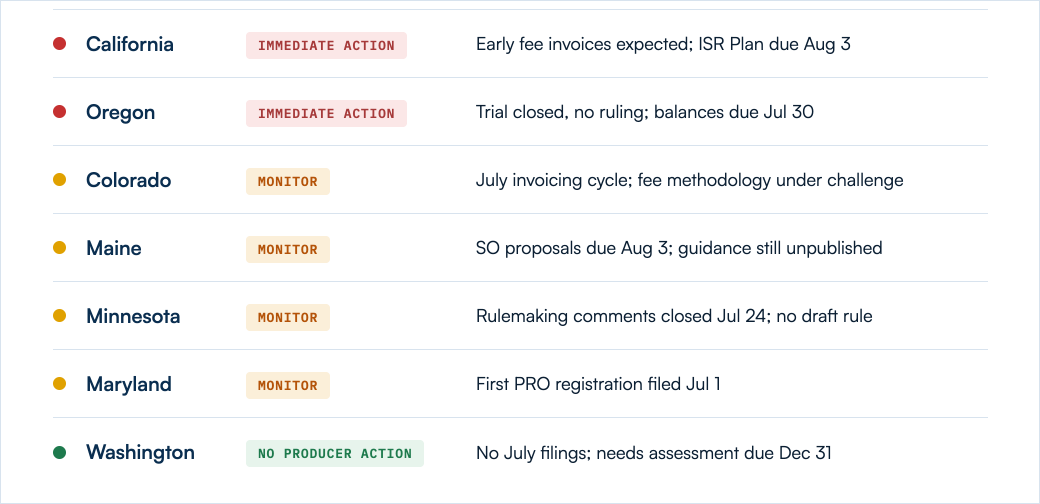
The seven states are moving at different speeds, and July widened the spread. Oregon closed its first program year with published costs, California moved from filing to invoicing, Maine is still selecting an operator, and Washington's rulemaking is dormant until late 2027 — one national brand now faces four different operating realities.
California
Immediate actionWhat happened
- CAA issued the final California Early Fee Schedule (July 2026) and signalled early-fee invoicing in August, based on 2025 supply data.
- ISR Plan Producer Guidance and the ISR Plan Workbook were revised in July to reflect new CalRecycle guidance.
- CAA held its program plan webinar July 8; the public comment period runs through August 14, with the final plan due to CalRecycle in October.
- The American Chemistry Council and the Alliance of California's Farmers and Ranchers moved to intervene (July 1) in the environmental groups' challenge to the SB 54 regulations.
- A coalition of California agricultural groups wrote to the Governor and legislative leadership on July 6 seeking repeal and replacement of SB 54.
Why it matters — Your first California invoice and your 2027 rate are both being determined right now, from different inputs: one from data already filed, one from a plan still open to comment.
Action — File the ISR Plan by August 3, reconcile the early-fee invoice against your own submitted data when it arrives, and submit program plan comments before August 14.
Oregon
Immediate actionWhat happened
- The NAW v. Feldon bench trial ran July 13–17 before Judge Simon. No ruling. Simultaneous post-trial briefs due July 31; motions on further oral argument due August 3.
- CAA published Oregon's 2025 annual report (July 2) — the first for any U.S. packaging EPR program.
- Remaining 2026 invoice balances were due July 30; late charges apply per the state addendum.
- Testimony clarified the enforcement split: CAA publishes producer delinquency lists, DEQ alone determines and exercises enforcement.
- The Lollicup USA class action was extended pending the NAW decision, with a joint status report due September 10.
Why it matters — Oregon is now the reference case for every other state: it has a full year of cost data, an active enforcement architecture, and an unresolved constitutional question hanging over all of it.
Action — Confirm your Oregon balance is clear, and if you rely on the injunction, verify your NAW membership predates February 6, 2026.
Colorado
MonitorWhat happened
- The Producer Responsibility Advisory Board met July 8; the CAA Colorado State Board met July 13.
- Second-cycle 2026 invoicing ran during July; remaining balances were due July 30.
- The ILMA challenge to CDPHE's approval of the lubricants individual program plan and its flat $0.56-per-gallon fee remains undecided.
Why it matters — Colorado is the first state where a fee methodology has been challenged as unrelated to actual recycling cost. The reasoning, whichever way it goes, will travel.
Action — Clear your July invoice and track the minimum recyclable list, which drives your malus exposure.
Maine
MonitorWhat happened
- The Stewardship Organization RFP remains open; proposals are due August 3.
- Producer and municipal guidance, both anticipated for summer, were still unpublished as of July 31.
Why it matters — Maine is the one state that has not designated CAA. Once an SO is contracted, producers get a 90-day registration window — and the data you will need is knowable now.
Action — Assemble your Maine packaging-supply data ahead of the fall award.
Minnesota
MonitorWhat happened
- The MPCA rulemaking Request for Comments closed at 4:30 p.m. on July 24. No draft rule has been published.
- CAA filed Minnesota's first PRO registration with MPCA on July 1.
Why it matters — Definitions and covered-material lists are being drafted from the comments just received. The next visible artifact is a draft rule you will have far less room to reshape.
Action — Watch for the draft rule and check whether your materials landed inside the covered definitions.
Maryland
MonitorWhat happened
- CAA filed Maryland's first PRO registration with MDE on July 1, including the list of participating obligated producers and brands.
- MDE's COMAR 26.04.14 compliance guide with FAQs and the exempt/excluded producer determination form (both June 2026) remain the operative producer documents.
Why it matters — Producer reporting closed May 31. If you missed it, you are not registered by association — you are unregistered.
Action — Confirm your company appears on the filed participating-producer list; if not, open a CAA Producer Services case.
Washington
No producer actionWhat happened
- No new documents in July. The WAC 173-950 draft-language comment period closed June 24; the next milestone, CR-102, is estimated for October 2027.
- Ecology's preliminary needs assessment is due December 31, 2026.
Why it matters — Washington's fee basis will be built on the needs assessment, not the rule text. That is the document to read when it lands.
Action — No filing this month. Keep your Washington simplified supply data current.
The full deadline calendar
Dates run through January 1, 2027.

Removed this month: October 4, 2026 — California SB 343 recyclability-labeling requirements. A federal court enjoined enforcement on July 14. Delete it from your calendar, but keep the note; an injunction is not a repeal.
California ISR Plan — due August 1 (effective August 3)
The statutory date is August 1, which falls on a Saturday. Under CAA's reporting policy, a report date landing on a weekend or holiday shifts to the next business day — making the operative cutoff 11:59 p.m. PT on Monday, August 3. Do not let that extra weekend become the reason the filing is thin. Every first-year filer must document the CY2023 plastic baseline, progress to date, and a concrete path toward the statutory targets of 10% reduction by 2027, 20% by 2030 and 25% by 2032.
It is also a financial instrument: documented prior reductions feed the source reduction incentive mechanism. And note one constraint that catches producers late — submitted California Baseline Reports cannot currently be updated, so a baseline error propagates straight into the ISR Plan.
The documents that decide what you pay
July's documents were operational rather than legislative — the fee schedules, workbooks, and one first-ever accounting of where producer money actually went.
Oregon — CAA 2025 Annual Report
Circular Action Alliance · July 2, 2026
Why read it: it is the first published accounting of any U.S. packaging EPR program — what producer fees funded, and CAA's own statement that year-one costs came in below projection with heavier 2026–2027 spending ahead.
View report →California — Early Fee Schedule
Circular Action Alliance · July 2026
Why read it: these are the operative early-fee rates, replacing earlier estimates, and the basis for the invoices expected in August. The illustrative fee ranges published in May were planning figures only.
Access via the CAA Producer PortalCalifornia — ISR Plan Producer Guidance and ISR Plan Workbook
Circular Action Alliance · revised July 2026
Why use it: the revised guidance reflects new CalRecycle direction, and the workbook is the calculation tool behind the August 3 filing.
Access via the CAA Producer PortalCalifornia — CAA Program Plan, comment through August 14
Circular Action Alliance · webinar held July 8
Why engage: more than 350 pages covering budget development, fee-setting, eco-modulation, and reimbursement. It sets your 2027 rate structure, and the window closes August 14.
Comment portal →California — Extensions, Exemptions and Exclusions
CalRecycle
Why read it: the operational route for small-producer and agricultural exclusions, including what documentation CalRecycle actually wants. Note that its producer guidance page still lists "Identifying Covered Materials" and "Are You a Producer?" as coming soon — confirm before relying on either.
View guidance →Maryland — COMAR 26.04.14 Compliance Guide and exemption form
Maryland Department of the Environment · June 2026
Why read it: the operative producer-facing guide for a program whose registration cycle has already closed once.
Compliance guide →Maine — Stewardship Organization RFP, proposals due August 3
Maine DEP
Why watch: the award starts the clock on Maine producer registration this fall.
DEP program page →Two shifts worth operationalizing
Who enforces, and who only publishes
Testimony in the Oregon trial made the enforcement architecture explicit for the first time: CAA is obligated to publish producer delinquency lists, but DEQ alone determines and exercises enforcement. As of July, no monetary penalties had been publicly announced in Oregon. The distinction matters more than it sounds. Appearing on a delinquency list is a reputational and commercial event that arrives long before any regulatory penalty does — and it is triggered by a PRO applying its own policy, on its own timetable, not by a state enforcement decision. Producers who are modelling penalty risk are modelling the wrong exposure.
The consultant of record becomes a registration field
CAA has added a Primary Consultant contact field to producer registration. The designated consultant receives the same communications as the primary contact, with the explicit exception of legally binding agreements and invoices, and is designated through a Help and Support case. This is a small mechanical change with a real implication: the PRO now recognises, at the registration layer, that many producers do not operate their own compliance. Producers using outside support should designate deliberately rather than routing regulatory correspondence through whoever happened to create the account.
“That's not our role. We're building. We support the producers.”
— Jeff Fielkow, CEO, Circular Action Alliance, rejecting the characterisation of the PRO as a private regulator
Why this sentence matters — It is the exact question the Oregon court reserved for post-trial briefing: whether a private entity may set mandatory fees without public process or an independent contest mechanism. Whatever the court decides, the producer-side lesson is already available. The entity issuing your invoice is not the entity that will enforce against you, and neither one is obligated to reconstruct your numbers for you.
What a record is for now
The transition from filing to invoicing changes what a compliance record is for. During the registration phase, the record's job was to be submitted. Now its job is to be defended — against a fee calculation, a validation request, or a category dispute, months or years after the data was assembled. A number you filed but cannot reconstruct is not a compliance position; it is an exposure with a due date attached. The producers who will handle 2027 well are the ones building the reconstruction path now, while the underlying data is still recoverable.
What to track next
NAW v. Feldon ruling (Oregon) — briefing closes August 3; a decision could issue at any point after, and would be the first judicial word on whether a PRO may set mandatory fees.
California program plan comments (through August 14) — the last structured input into 2027 rates and eco-modulation.
California early fee invoices (August) — the first real test of whether producers can reconcile a bill against their own submitted data.
Maine stewardship-organization award (proposals due August 3) — triggers the producer registration clock this fall.
ILMA v. CDPHE (Colorado) — an update was expected as of mid-July; the fee-methodology reasoning will travel to other states.
Could you reconstruct the numbers already filed on your behalf?
We map exactly what applies to you across all seven states — and what stands behind every number you have filed.
Get a free EPR Compliance Status Check →Put this month to work
Planning your 2027 EPR budget?
Estimate how packaging classification could move your fees before the 2027 rates are locked in.
Try the estimatorInstant estimate
Related insights
Subscribe to EPR Intelligence
The monthly operational briefing on U.S. Packaging EPR — deadlines, enforcement, and what to do this month.
One email a month. No legal jargon.
Opt-in only · unsubscribe anytime