Lead Insight
Litigation doesn't suspend compliance
The lawsuits are loud. The deadlines are real.
The principle
A lawsuit is not a pause button. Until a court actually suspends a program, producers remain responsible for every registration, report, and fee deadline. And every major U.S. packaging EPR law is now being challenged in court — so it is tempting, especially when a coalition of state attorneys general joins in, to read a filing as permission to wait. For producers, that instinct is almost always wrong: a challenge to a law does not suspend the obligations it creates, and any injunction protects only the specific parties it names. This month made the principle unusually concrete.
What June delivered
On June 22, seventeen state attorneys general, joined by the National Association of Wholesaler-Distributors (NAW), filed a federal lawsuit challenging California's SB 54 on Commerce Clause and First Amendment grounds. Three weeks earlier, a very different set of plaintiffs — Oceana, NRDC, and Californians Against Waste — sued CalRecycle from the opposite direction, arguing the same rules are too weak. And in Oregon, the first full trial on whether a U.S. packaging EPR law is constitutional is set to begin July 13.
Two suits pulling in opposite directions and a landmark trial — and not one compliance deadline moved.
What Oregon already proved
Regulators have shown they will enforce, and collect. In April, Oregon DEQ published its first public list of noncompliant producers — roughly 250 companies, including household names — for failing to register, report, or pay. DEQ paired it with a message worth reading twice: it will not refund fees even if the constitutional challenge ultimately succeeds. The state has already priced in the litigation risk and decided producers carry it, not the program.
Why the injunctions are narrower than they look
Oregon's injunction only protects companies that were NAW members as of February 6, 2026. If you are not in that specific group, you are fully subject to enforcement today — lawsuit or no lawsuit — and even covered members face the unresolved question of back-penalties if the state prevails.
What happens next
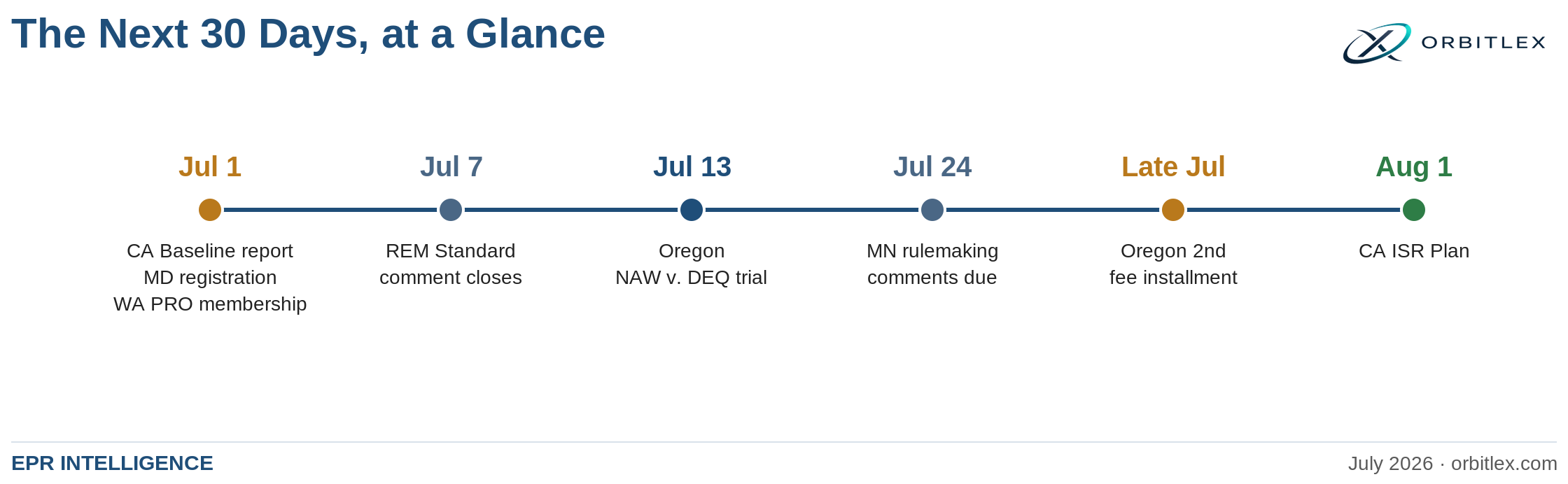
The calendar does not wait. In the next 60 days, California's Baseline Report (July 1) and ISR Plan (August 1), Maryland's registration (July 1), Washington's PRO-membership requirement (July 1), and Oregon's second fee installment (late July) all come due — each carrying per-day penalty exposure, none suspended by any pending case. And comply while a program is later struck down, and you still keep an accurate, defensible record of your own packaging — an asset under every outcome.
What producers should do now
- Register in every state where you have obligations — CA (PEPRS), OR, CO, MD, WA. Being unregistered is the single highest-penalty posture.
- Meet the July and August filing dates as if no lawsuit existed: CA Baseline (Jul 1), MD registration (Jul 1), WA PRO membership (Jul 1), OR installment (late Jul), CA ISR Plan (Aug 1).
- Confirm — if you rely on the Oregon injunction — that your NAW membership predates February 6, 2026, and preserve documentation of covered products introduced since.
- Protect your baseline data as a permanent asset, not a filing: accurate CY2023 packaging weights and covered-material classifications survive any court outcome.
A lawsuit changes headlines, not your filing obligations.
EPR Number of the Month
Producers named on Oregon DEQ's first public noncompliance list.
The clearest signal yet that packaging EPR enforcement has left the theoretical stage. The list spans industries and includes well-known national brands — a reminder that "we were waiting on the lawsuits" is not a defense once a deadline has passed.
What Changed This Month
State updates
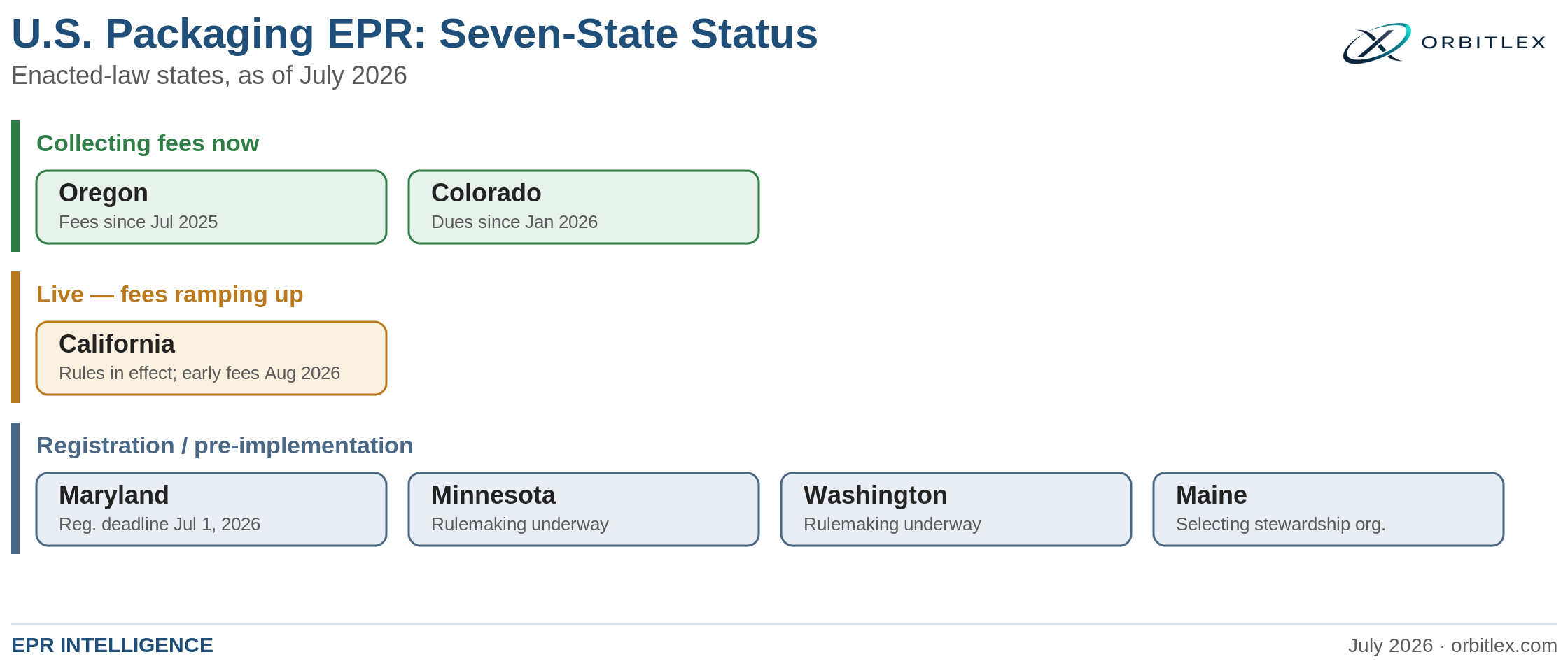
All seven enacted-law states are now in active implementation. With Maryland's regulations in effect and Maine issuing its stewardship-organization RFP, single-state tracking is no longer enough for a national brand — obligations, deadlines, and even definitions now differ state by state.
California
Immediate actionWhat happened
- CAA submitted its draft Program Plan (June 15; fee chapter corrected June 18); comment open through August 14.
- CalRecycle published Extensions, Exemptions & Exclusions guidance and a video (June 18).
- Two opposing lawsuits filed — enviro groups (June 2) and a 17-state coalition plus NAW (June 22).
Why it matters — Your 2027 fees and exemption options are being set right now, while the program's legal footing is contested — but none of it moves the July/August filings.
Oregon
Immediate actionWhat happened
- The NAW v. DEQ constitutional trial begins July 13.
- The second 2026 fee installment is due in late July.
- DEQ approved CAA's Responsible End Markets (REM) plan amendment; RMA rulemaking continues (next advisory meeting July 20).
Why it matters — Fees stay due and enforceable through the trial, and end-market rules are tightening.
Colorado
No action this monthWhat happened
- No new statute; the ILMA suit over PPSA fee implementation continues.
- CAA launched a Service Provider Portal training series (June 12).
Why it matters — The program is operating normally; your 2027 dues hinge on how materials move on and off the Additional Materials List.
Maine
MonitorWhat happened
- DEP issued the Stewardship Organization RFP (June 15); proposals due August 3.
- Producer guidance is expected this summer.
Why it matters — Registration can't begin until an SO is chosen, but the data you'll need is knowable now.
Minnesota
MonitorWhat happened
- MPCA published its first rulemaking Request for Comments (May 26); comments due July 24.
- A June 17 advisory-board packet introduced reimbursement-rate options.
Why it matters — The definitions and exemptions being drafted now decide whether your materials are covered.
Maryland
Immediate actionWhat happened
- Regulations (COMAR 26.04.14) took effect May 25; individual registration due July 1.
- For e-commerce, the entity that packages goods for shipment is the producer of that shipping material.
Why it matters — The e-commerce definition can make you a producer even where you'd assume otherwise.
Washington
Immediate actionWhat happened
- First WAC 173-950 draft rule published; the initial comment period closed June 24, with further comment expected as rulemaking continues.
- PRO membership due July 1; CAA's payment to Ecology due September 1.
Why it matters — Early rules will set the fee basis and reporting, but membership is the immediate obligation.
Upcoming Deadlines
The full deadline calendar
Dates run through November 30, 2026.
| Date | Requirement | Applies to | Type |
|---|---|---|---|
| This week · through Jul 8 | |||
| Jul 1 | California — Baseline Producer Report (CY2023) in PEPRS | All SB 54 producers | Mandatory |
| Jul 1 | Maryland — Individual-producer registration with MDE | Producers not via CAA | Mandatory |
| Jul 1 | Washington — Membership in a registered PRO | All obligated producers | Mandatory |
| Jul 7 | National — REM Standard public comment closes | All producers | Consultation |
| Jul 8 | California — CAA Program Plan informational webinar | All producers | Webinar |
| This month · Jul 13 – late Jul | |||
| Jul 13 | Oregon — NAW v. DEQ trial begins (5 days) | Monitor; NAW members | Watch |
| Jul 20 | Oregon — RMA rulemaking advisory meeting | Stakeholders | Consultation |
| Jul 24 | Minnesota — Rulemaking RFC comments due | All producers | Consultation |
| Late Jul | Oregon — Second 2026 fee installment (confirm on CAA invoice) | Non-exempt OR producers | Mandatory |
| Coming soon · Aug 1 – Aug 14 | |||
| Aug 1 | California — Individual Source Reduction (ISR) Plan | All SB 54 producers | Mandatory |
| Aug 3 | Maine — SO RFP proposals due | SO applicants only | Watch |
| Aug 14 | California — CAA Program Plan comment closes | All producers | Consultation |
| Later · Sep – Oct 2026 | |||
| Sep 1 | Washington — CAA one-time payment to Ecology | CAA (on producers' behalf) | Mandatory |
| Oct 2026 | California — Final plan + 2027 fee schedule published | Plan for fee impact | Watch |
Deadline Spotlight
California ISR Plan — due August 1 (effective August 3)
This is the first real operational obligation of the SB 54 program, not just a registration. Every first-year filer must submit an Individual Source Reduction Plan documenting the CY2023 plastic baseline, 2025 progress, and a concrete path toward the statutory targets (10% reduction by 2027, 20% by 2030, 25% by 2032). It is also a financial lever: documented prior reductions can earn fee relief. If you sell plastic packaging into California, this is the filing that turns "we're registered" into "we're actually reducing" — and it needs real data behind it, not an estimate.
New Guidance & Resources
The documents that decide how you comply
The month's most consequential documents were operational, not legislative — the guidance, tools, and open consultations that determine how you comply.
California — Extensions, Exemptions & Exclusions
CalRecycle · June 18
Why read it: it tells you whether you qualify for the small-producer (<$1M gross sales) or agricultural exclusion — which can remove you from the program entirely.
View guidance →California — PEPRS exemption / exclusion submission modules
CalRecycle · PEPRS
Why use it: it's the only channel for filing an exclusion claim. Note the de minimis and agricultural databases are still "coming soon," so those pathways can't yet be self-certified.
Access via your PEPRS accountColorado — Service Provider Portal training series
CAA · June 12
Why use it: it walks through reporting mechanics for local governments and processors — relevant if you run a closed-loop or in-house recycling stream.
Available through CAACalifornia CAA Program Plan — comment through August 14
Informational webinar July 8
Why engage: it sets your 2027 fee rates and eco-modulation structure — this is your window to influence them.
Comment portal →National REM Standard — comment closes July 7
Circular Action Alliance
Why engage: it defines which recycling end markets "count." Materials reaching non-certified markets may not credit toward your recycling targets.
Comment page →Minnesota rulemaking RFC — comments due July 24
MPCA
Why engage: it's the earliest chance to shape Minnesota's definitions and covered-material lists — before your materials are locked in as covered.
RFC document →Operational Practice Watch
Two shifts worth operationalizing
State fee divergence
The seven programs are pricing the same materials differently, and the gap is widening. In its June 11 briefing to Washington's advisory council, CAA showed that identical PET thermoforms can carry fees varying by well over 100% depending on each state's classification — residential recycling, public-place, or alternative collection. For a national brand, one SKU is now a different line item in every state, and any fee model built for a single program will misstate the others.
Responsible end markets
End-market accountability is acquiring its first formal rulebook. In the same month, Oregon DEQ approved CAA's REM amendment — benchmarking nine third-party certifications — and CAA opened public comment on a national REM Standard. The direction is unmistakable: producers will increasingly have to demonstrate that their materials reach verified, responsible end markets, not merely that they were collected. Where your packaging ultimately goes is becoming a reportable compliance data point.
Quote of the Month
There is no basis for refunding fees.— Oregon DEQ, on producers seeking relief from EPR fees while the law is challenged in court
It captures the regulator's whole posture in eight words: the fee obligation rests on statutes that remain in effect, and money paid now is not recoverable later. Betting on a court win doesn't give back the deadlines — or the penalties — you skipped in the meantime.
Orbitlex Perspective
What outlasts the headlines
One structural fact outlasts this month's headlines: the seven states are diverging, not converging. The same package is classified and priced differently in each, and every rulemaking widens the gap. The durable advantage won't be legal certainty — it will be holding one clean packaging dataset you can reshape to seven definitions on demand.
Watchlist
What to track next
- Oregon trial (July 13) — the ruling could reshape how every state runs its EPR program.
- California Program Plan comments (through August 14) — the last chance to influence 2027 fee rates.
- Maine stewardship-organization selection (proposals due August 3) — triggers the producer-registration clock this fall.
Not sure which of these obligations apply to your business?
We map exactly what applies to you across all seven states.
Request a free EPR Compliance Status CheckSubscribe to EPR Intelligence
The monthly operational briefing on U.S. Packaging EPR — deadlines, enforcement, and what to do this month. One email a month. No legal jargon.