EPR Intelligence ·
Appeals take time. Comment windows close this fall.
None of the pending cases has a scheduled decision date.
The comment windows close between October 19 and November 13.
In 30 seconds
- Oregon's case went to the state. Judgment for the state was entered on August 28; Holland & Knight reads that as ending the February preliminary injunction. NAW filed its notice of appeal to the Ninth Circuit on September 24.
- No stay has been reported. As of September 27, no stay pending appeal has been reported, and Oregon's program continues to register, invoice and enforce while the appeal runs. Ninth Circuit civil appeals have historically taken well over a year from notice to decision.
- Four comment windows close between October 19 and November 13. Oregon closes two (October 19 and October 30), California one (October 24), Minnesota one (November 13). Each can change what producers report or pay.
- Oregon's third rulemaking proposes new covered-product exemptions — raw-meat film, garbage bags and leased reusable plastic containers are named in the notice — plus Recycling Acceptance List changes and measures aimed at fees DEQ calls "out-of-scale with the impacts" of some producers' products.
- CalRecycle set out how to file a categorical-exclusion notice for food and agricultural packaging (August 27, through PEPRS). Once a notice is deemed complete, the exclusion covers the identified packaging for the specified products without each brand filing; CalRecycle can later find that packaging does not qualify. The public list is not yet posted.
- Maryland's compliance guide is now Rev 1 (September 2026): de minimis is under 1 ton of covered material into the State or under $2,000,000 in global gross revenue — the "or" does real work.
Lead Insight
Appeals take time. Comment windows close this fall.
The principle
For nine months the most-watched question in U.S. packaging EPR has been whether the courts would take these programs away. September answered a smaller and more useful version of it: not yet, and not soon. Oregon's judgment stands, the February injunction no longer protects anyone on Holland & Knight's reading of that judgment, and the appeal that follows has no schedule; Ninth Circuit civil appeals have historically taken well over a year. Meanwhile four comment windows opened or continued that will set what producers report and what they pay in Oregon, California and Minnesota — and every one of them closes before Thanksgiving. The litigation is the story people follow. The comment windows are where the money is decided.
What September delivered on Oregon
On September 24 the National Association of Wholesaler-Distributors filed a notice of appeal to the U.S. Court of Appeals for the Ninth Circuit in NAW v. Feldon, challenging Judge Michael H. Simon's August 27 decision upholding the Recycling Modernization Act. Two things travel with that filing.
First, the February 6 preliminary injunction should not be relied on. Judgment for the state was entered on August 28, and Holland & Knight describes the injunction as "effectively dissolved by the entry of judgment in favor of the state" — which updates what this briefing reported last month; see the update below. Producers who were inside its scope should not treat it as continuing protection.
Second, an appeal is not relief. NAW is challenging the August 27 decision, and its president put the position plainly: "The facts we established at trial haven't changed, and they still show Oregon's law is unconstitutional." The district court itself noted that "few material facts are truly disputed by the parties" and that the issues are "for the most part, questions of law," which an appellate court reviews afresh. The trial record alone therefore does not tell anyone how the appeal will come out. What is settled is the practical point: filing an appeal does not suspend compliance obligations. Relief during the appeal would require a stay, requested separately under Federal Rule of Appellate Procedure 8, and none has been reported. Oregon keeps running.
An appeal changes who decides. It does not change what you owe while they decide.
What September delivered on the comment windows
Four are open, and none is a consultation about principle. Oregon DEQ's third Recycling Modernization Act rulemaking runs to 4 p.m. on October 30, with hearings October 20 and 21 and Environmental Quality Commission adoption anticipated in January or February 2027; it proposes new covered-product exemptions, Recycling Acceptance List changes covering glass and pressurized cylinders, and measures aimed at fees DEQ calls "out-of-scale with the impacts" of some producers' products. Separately, DEQ takes comment to 5 p.m. Pacific on October 19 on CAA's third Oregon program plan amendment, which changes a key metric from diversion rate to pounds of USCL commingled material collected per household, adds a statement allowing CAA to update glass packaging fees if the regulations change, and adjusts covered material classifications, which CAA wants approved by December 2026 so its producer portal can use them for 2027 reporting.
In California, CAA's draft Funding & Services Agreement and its three Project Schedules are open until October 24. That document sets what CAA pays recycling and reuse service providers: producers have nothing to file and everything at stake, because what CAA pays out is a cost its producer fees have to cover. In Minnesota, MPCA's draft 2026 Needs Assessment, prepared by Eunomia, closes November 13 and carries a recommended methodology for reimbursing service providers — the cost base for a program under which service providers must be reimbursed at least 50% of net cost by February 1, 2029.
Why this matters together
These decisions are being made now, on published schedules, whatever the courts later decide. A producer who follows the appeal and skips the Oregon exemption list is watching the wrong calendar. A comment window is a point where a producer can respond in writing before the text is final, rather than after a rate is invoiced.
What producers should do now
- Read Oregon's proposed exemptions against your own formats, not against a summary. The notice names film and flexible plastic packaging in direct contact with raw meat, excluding trays (proposed to expire in 2032); garbage bags not marketed as fulfilling a recycling purpose; and leased reusable plastic containers. The draft rules carry the full list with the operative language. A proposed exemption is not yet an exemption: keep reporting that packaging until DEQ adopts the rule, and check the effective date when it does.
- If you were covered by the February injunction, confirm your position for that period. The injunction restricted DEQ enforcement against NAW and its members as of February 6. According to DLA Piper's February analysis, the court contemplated possible recovery of unpaid fees if Oregon prevailed, while leaving retroactive daily penalties unresolved. Former beneficiaries should confirm their registration, reporting and fee position, including how the injunction period will be treated.
- Do not wait for the Ninth Circuit. As of September 27, no stay has been reported, and a civil appeal there historically runs well past a year. Budget and report on the assumption that Oregon bills through the appeal.
- Comment on the CAA California Funding & Services Agreement by October 24 if your formats are unusual. Payout terms for a material you supply are fee terms for you, one step removed.
- Put November 13 in the Minnesota file now. The reimbursement methodology in the draft Needs Assessment is open for comment until November 13; the reimbursement floor it feeds applies from February 1, 2029.
Key takeaway
An appeal sets no deadline for producers. The four comment windows do: October 19, October 24, October 30 and November 13.
EPR Number of the Month
closing between October 19 and November 13, 2026, each of which changes what producers report or what they pay — in Oregon (two), California (one) and Minnesota (one).
None requires a filing. All of them are decided in writing, in public, before the numbers exist. By contrast, neither the Colorado nor the California challenge has a scheduled decision date, and the Oregon appeal has only just been filed.
What Changed This Month
State updates
September resolved Oregon's posture and moved the action into rulemaking. California published a new exclusion route and a fee-relevant consultation, and lost a spending-transparency bill to a veto. Maryland reissued its compliance guide. Minnesota opened its Needs Assessment. Maine confirmed it is starting its operator search over. Colorado and Washington moved on schedule.
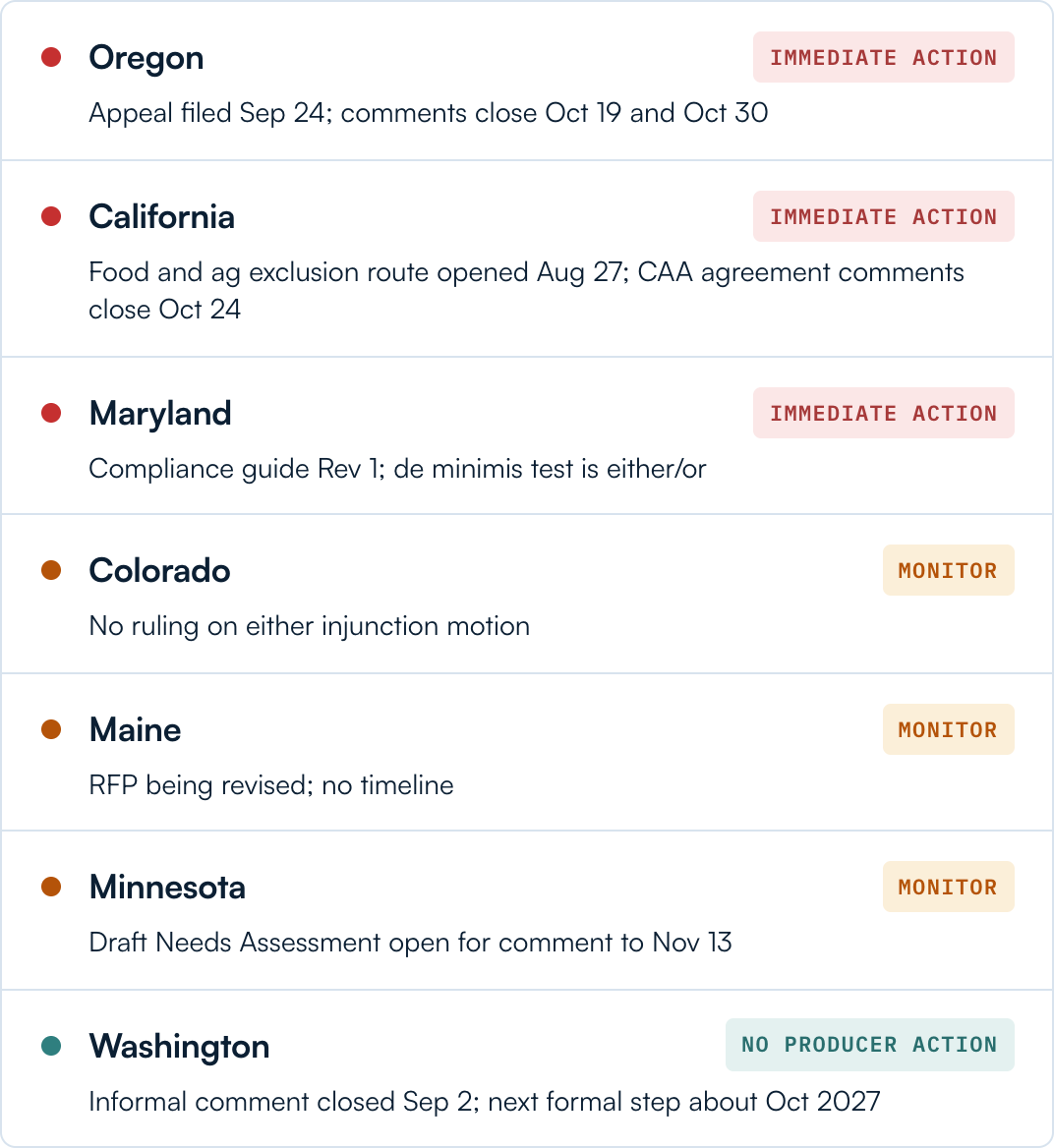
Each state below is tagged for what it requires of you this month: Immediate action · Monitor · No producer action
Oregon
IMMEDIATE ACTIONWhat happened
- NAW filed a notice of appeal to the Ninth Circuit on September 24, challenging the August 27 decision. As of September 27, no stay pending appeal has been reported; the program continues.
- Judgment for the state was entered August 28; Holland & Knight reads that as ending the February 6 preliminary injunction ("effectively dissolved by the entry of judgment"). Its scope had been narrowed in April 2026 to NAW members as of February 6.
- Third RMA rulemaking is out for comment. Deadline 4 p.m., October 30, to RMARulemaking3@deq.oregon.gov. Hearings October 20 at 10 a.m. and October 21 at 6 p.m. EQC adoption anticipated January or February 2027. Scope includes Responsible End Market clarifications, Recycling Acceptance List changes covering plastic packaging, pressurized cylinders and glass collection, the "effectively composted" definition, convenience standards, transportation cost reimbursement, producer obligation clarifications and new covered product exemptions.
- CAA's third Oregon program plan amendment is separately out for comment until 5 p.m. Pacific, October 19, to RethinkRecycling@deq.oregon.gov. It changes a key metric from diversion rate to pounds of USCL commingled material collected per household, adds a statement allowing CAA to update glass packaging fees if the regulations change, updates the Specifically-Identified Materials sections to reflect DEQ's April 1, 2026 removal of that designation for glass and shredded paper, and adjusts covered material classifications.
- CAA updated its searchable registry of Oregon producer members on September 22.
- CAA published Oregon's 2027 fee schedule on October 1. It returns about $80 million in program reserves and $3 million in previously collected SIM fees to producers through reduced rates, invoiced in two halves, January and July 2027. Glass bottles and jars carry a base rate of $0.04 per pound and, after reserve drawdowns, a final rate of $0.00.
Why it matters — Two separate documents, two separate deadlines eleven days apart, both changing what gets reported and what it costs. Read the glass clause alongside the rulemaking: DEQ's notice put the 2026 glass fee at $0.10 per pound and projected a partial reduction in 2027; CAA's 2027 schedule, published since, lists a $0.04 base rate. The final rates include reserve drawdowns CAA describes for 2027; plan beyond 2027 from the base rates.
Action — Calendar October 19 and October 30 as two items, not one. Check your formats against the proposed exemption list in the draft rules. Confirm your entity and brands appear correctly in the updated registry. Former injunction beneficiaries: confirm your position for the injunction period; see the update below the deadline table.
California
IMMEDIATE ACTIONWhat happened
- CalRecycle published Guidance for Submitting a Categorically Excluded Materials Notice for Food and Agricultural Commodity Packaging on August 27. Filed through the PEPRS portal, by a company or by an association on behalf of members. The submission must identify the packaging and its function, tie it to specific products, cite the federal food and agricultural requirements that conflict with the Act, and show no reasonable alternative packaging avoids the conflict. CalRecycle notifies a filer within 90 days if a notice is incomplete. Once a notice is deemed complete, the exclusion applies to the identified packaging in association with the specified products or class of products, without each company or brand filing individually, and CalRecycle lists it on its website. CalRecycle may later request supporting information and, if it finds the packaging does not qualify, that packaging becomes covered material 180 days after notification.
- CAA opened comment on the draft California Funding & Services Agreement and three Project Schedules — Services, Cost Reimbursement and Capital Investment — running August 26 to October 24.
- CAA's California page carries October 13, 2026 for the PRO's submission of the final draft program plan to CalRecycle, in a timeline it attributes to CalRecycle. CalRecycle's own SB 54 pages still publish no date for its approval action.
- Governor Newsom vetoed SB 1180 on September 20. It would have set spending rules for the Plastic Pollution Mitigation Fund, including caps on indirect-cost reimbursement and state administrative costs and annual public expenditure reporting. The veto message said the work is already underway and the bill risked complicating implementation.
- CAA issued California early-fee invoices from 2025 supply data in late August. Payment terms run from the invoice.
- CAA published a 2027 California fee schedule on October 1 and marks it preliminary: the rates are non-binding until the program plan is approved. Fees are to be invoiced 50% in January and 50% in July 2027, with a separate January invoice for the Plastic Pollution Mitigation Fund portion. CAA's forecast puts 49¢ of every 2027 producer-fee dollar into the mitigation fund.
Why it matters — The categorical-exclusion guidance is a formal procedure for excluding specific packaging from SB 54, and it is narrow by design: a conflict with federal food and agricultural requirements, not a commercial inconvenience. The veto leaves producers funding the mitigation fund from 2027 with less published detail about how it will be spent — and on CAA's preliminary forecast, the fund is the largest single use of California fees.
Action — If you have ever argued that a food or agricultural format cannot comply because federal rules govern it, this is the prescribed procedure. Check CalRecycle's list once it is posted, because a complete notice covers the identified packaging whoever filed it, and keep your own documentation, because an exclusion can be reviewed after the fact. Read the Funding & Services Agreement as a fee document and comment by October 24. Take payment dates from your invoice, not from a tracker.
Maryland
IMMEDIATE ACTIONWhat happened
- MDE issued Rev 1 of the Producer Responsibility — Packaging and Paper Products Regulations Compliance Guide and FAQs, dated September 2026, an FAQ and clarification document for COMAR 26.04.14.
- Confirmed in Rev 1: a de minimis producer is one that in its most recent fiscal year either introduced less than 1 ton of covered material into the State or earned global gross revenues of less than $2,000,000. Registration was due July 1, 2026 and is due annually by June 30 thereafter. Individual Producer Responsibility Plans are due July 1, 2028, or a later date identified by the Department. From October 29, 2028, or a later date identified by the Department, a producer may not sell, offer for sale, distribute or import covered materials for use in the State without an approved responsibility plan on file for each covered material.
- Records must be kept a minimum of five years and produced within 15 business days, or on a timeline MDE specifies, whichever is later.
- The guide also covers food serviceware definitions, the packaging-versus-paper-products boundary, exempt categories and alternative collection programs.
Why it matters — The de minimis test is disjunctive. A producer under 1 ton qualifies regardless of revenue, and a producer under $2,000,000 in global gross revenue qualifies regardless of tonnage. Read with an "and", it sends exempt producers into registration.
Action — Re-test your Maryland position against Rev 1 rather than the June version, and re-check your packaging-versus-paper-products and food serviceware classifications while you are in the document. Confirm you can produce records inside 15 business days.
Colorado
MONITORWhat happened
- No ruling on either injunction motion. NAW v. Ryan (D. Colo., 1:26-cv-03460-PAB) remains in briefing following NAW's August 5 motion; docket trackers report the state's opposition filed September 16 and a scheduling conference October 21. ILMA's separate state-court motion, filed August 18 in Denver District Court, seeks relief for its members only and expressly does not seek to halt the program. None of this is confirmed from the docket here, and no relief has been granted anywhere.
- CDPHE published no packaging EPR documents, notices or comment periods in the window. An amendment to 6 CCR 1007-2 Part 1 §1.8 concerning producer responsibility authorization and the dollar-limit exemption is listed among proposed rulemakings with no dates attached.
- CAA published the 2027 Colorado dues schedule on October 1, the rule's deadline. Dues will be invoiced in two halves, January and July 2027, and the rates include the passive eco-modulation factors state law requires.
- Operationally the program is scaling — funding agreements with Cortez, Dolores and Oak Creek announced September 16, plus five service agreements, including one with Boulder County. The state's three largest haulers — Republic Services, Waste Connections of Colorado and Waste Management — have not signed.
Why it matters, and what to do — Nothing about Colorado obligations has changed, including the two-registry point covered last month. The 2027 dues schedule arrived on the rule's deadline (6 CCR 1007-2 Part 1 §18.9.2); the 2026 schedule had been published October 13, 2025. Run your 2026 supply data through the 2027 rates and plan cash for the January invoice.
Maine
MONITORWhat happened
- DEP announced on September 11 that it is revising the RFP. Its statement in full: "The Department is currently reviewing necessary updates to the Request for Proposals (RFP) for the Stewardship Organization and will inform stakeholders once the revised RFP is available." No revised timeline and no target date.
- This follows the August 18 close with zero bids and CAA's decision not to bid. The original RFP was published through the Office of State Procurement Services Vendor Self-Service System; DEP has not said where the revised one will appear.
- Chapter 428 remains in force, including the §9(B) presumption that packaging is received by the consumer unless the producer can verify otherwise.
Why it matters, and what to do — A rewrite is a longer path than a re-run. Nothing to file, no date to work against, and no basis for assuming relief — an unbuilt program is not an exemption. If your eventual Maine figure will exclude unsold stock returned unopened, the documentary verification Chapter 428 requires has to be preserved now, while the transaction records are still live.
Minnesota
MONITORWhat happened
- MPCA opened public comment on the draft 2026 Needs Assessment on September 14; it closes November 13. The draft was prepared by Eunomia Research & Consulting and submitted through MPCA's comment portal.
- Contents include a recycling rate baseline, collection and end-market investment recommendations, a recommended methodology for service provider reimbursement rates, sustainable design evaluation and education best practices.
- Rulemaking under Minn. R. ch. 7035 has still not produced a draft; the last formal step remains the request for comments published May 26.
Why it matters, and what to do — The reimbursement methodology is the cost base for a program under which service providers must be reimbursed at least 50% of net cost by February 1, 2029, and it is open for comment now, more than two years before that floor applies. Nothing to file; comment by November 13 if your material categories are unusual or your collection story is poorly represented in the baseline.
Washington
NO PRODUCER ACTIONWhat happened
- The second informal comment period on draft Chapter 173-950 WAC language, opened August 5, closed September 2. Advisory Committee meeting #2 was held August 19.
- CAA published Washington's 2027 early fee schedule on October 1: eight simplified material categories, from $0.002 per pound for glass and ceramics to $0.030 for wood and other organic materials. Early fees fund program development, startup and regulatory costs under the Recycling Reform Act.
- The preliminary needs assessment remains due December 31, 2026; the full assessment follows at the end of 2027.
- The formal track is unchanged: CR-102 around October 2027, hearings about December 2027, adoption around April 2028.
Why it matters, and what to do — The next formal comment opportunity is more than a year out, and the fee basis will come from the needs assessment rather than the rule text. No filing. Keep Washington simplified supply data current and watch the December 31 assessment.
Upcoming Deadlines
The full deadline calendar
Dates run through January 2027.
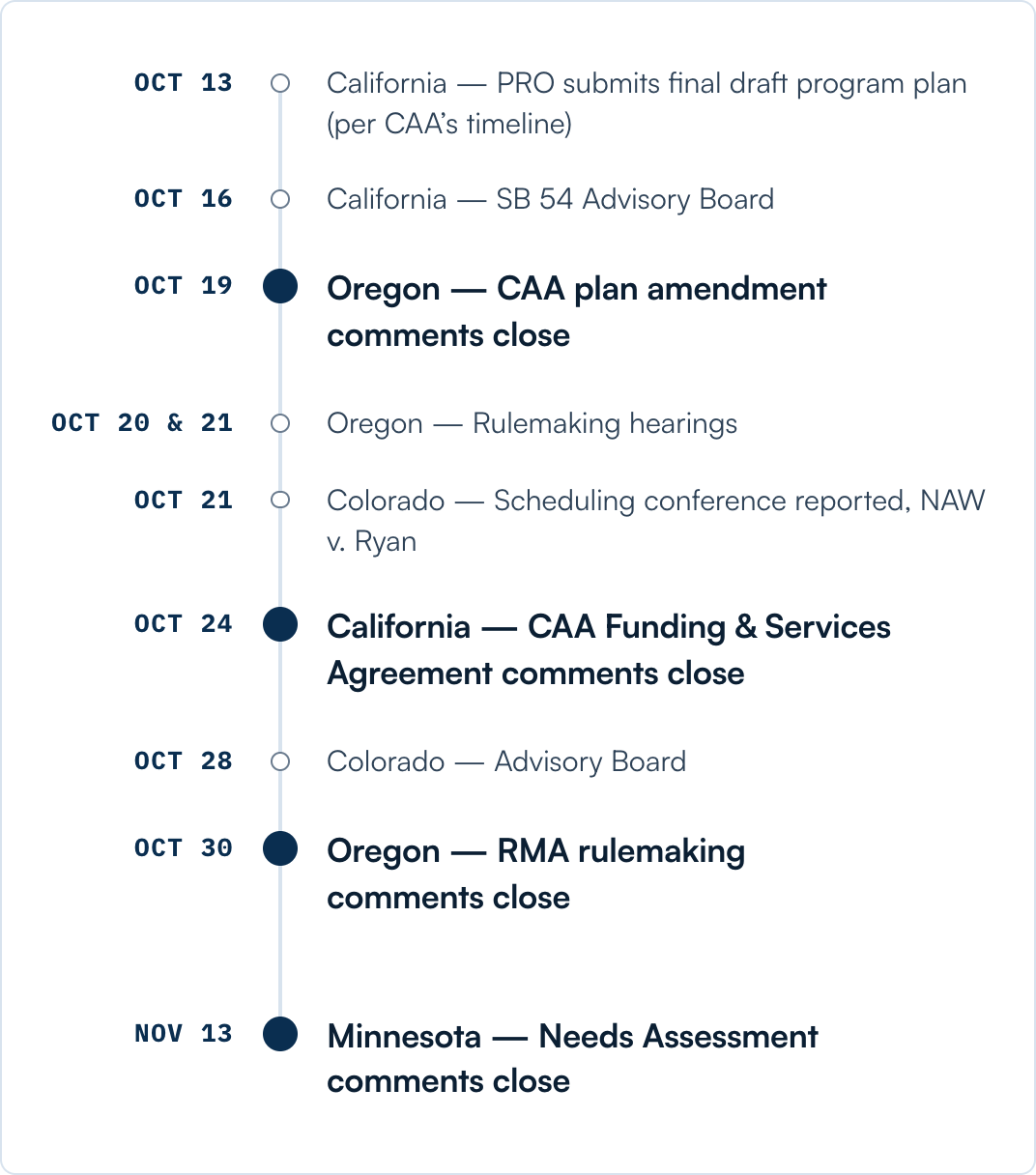
| Date | Requirement | Applies to | Type |
|---|---|---|---|
| This month | |||
| California — PRO submits the final draft California Program Plan to CalRecycle, per CAA's published timeline | All SB 54 producers | Watch | |
| California — SB 54 Advisory Board meeting, CalEPA HQ Sacramento, 10 a.m.–4 p.m. | SB 54 producers | Watch | |
| Oregon — Comments close on CAA's third program plan amendment (metric change, glass fee flexibility, covered material classifications) | Oregon producers | Consultation | |
| Oregon — Public hearings on the third RMA rulemaking, 10 a.m. and 6 p.m. | Oregon producers | Consultation | |
| Colorado — Scheduling conference reported in NAW v. Ryan | Colorado producers | Watch | |
| California — Comments close on CAA's draft Funding & Services Agreement and Project Schedules | All SB 54 producers | Consultation | |
| Colorado — Producer Responsibility Advisory Board, hybrid (virtual and in person), 1:30–4:30 p.m. | Colorado producers | Watch | |
| Oregon — Comments close on the third RMA rulemaking, including the proposed covered product exemptions | Oregon producers | Consultation | |
| November and December | |||
| Minnesota — Comments close on the draft 2026 Needs Assessment, including the service provider reimbursement methodology | Minnesota producers | Consultation | |
| Washington — Ecology preliminary needs assessment due | Fee-basis input | Watch | |
| Minnesota — Needs Assessment due | Fee-basis input | Watch | |
| Later | |||
| California — SB 54 producer fee obligations begin under CAA's plan | All SB 54 producers | Mandatory | |
| California — Preliminary injunction hearing requested by the 17-state coalition (with NAW) challenging SB 54 | Monitor | Watch | |
| Oregon — EQC adoption of the third RMA rulemaking anticipated | Oregon producers | Watch | |
Type: Mandatory · Consultation · Watch. Urgency is carried by the group headings, so color means one thing only.
Removed this month: "October — CalRecycle expected to act on CAA's program plan," carried last month. CalRecycle's approval action still has no published date, and the October 13 row above is CAA's submission, not CalRecycle's decision. Last month's "Oct 1 — final 2027 CAA fee rates" row has passed: CAA published on October 1, with California's rates still preliminary; see the state updates. Dropping the dates, not the obligations.
New Guidance & Resources
The documents that decide what you report and what you pay
September produced agency documents rather than filings — the reverse of August.
California — Guidance for Submitting a Categorically Excluded Materials Notice for Food and Agricultural Commodity Packaging (August 27, 2026)
Why read it: the filing procedure for excluding specific food and agricultural packaging from SB 54, and a narrow one. It sets the evidentiary burden — the conflicting federal food and agricultural requirements, the tie to specific products, the showing that no reasonable alternative packaging avoids the conflict — a 90-day window for CalRecycle to flag an incomplete notice, a public list of approved packaging, and the later review under which packaging can be found not to qualify.
Oregon — Notice of proposed rulemaking, Recycling Modernization Act Updates 2026 (comments close October 30, 2026)
Why read it: the proposed covered product exemptions and the Recycling Acceptance List changes are the two places a producer's own formats can move between fee treatments. Hearings October 20 and 21; EQC adoption anticipated January or February 2027.
Oregon — CAA third program plan amendment (comments close October 19, 2026)
Why read it: the metric change, the covered material classification adjustments and the glass fee flexibility language. This is a separate document from the rulemaking above, with a separate deadline and a separate submission address.
California — CAA draft Funding & Services Agreement and Project Schedules (comments close October 24, 2026)
Why read it: it governs what CAA pays recycling and reuse service providers, a cost that producer fees have to cover. Three schedules — Services, Cost Reimbursement, Capital Investment.
Maryland — Producer Responsibility Compliance Guide and FAQs, Rev 1 (September 2026)
Why read it: the operative Maryland reference, carrying the disjunctive de minimis test, the annual June 30 registration cycle, the July 1, 2028 Individual Producer Plan deadline, the October 29, 2028 sales prohibition without an approved plan, and the five-year retention with 15-business-day production.
Minnesota — Draft 2026 Needs Assessment, Packaging Waste and Cost Reduction Act (comments close November 13, 2026)
Why read it: it contains the recommended methodology for service provider reimbursement rates — the cost base for Minnesota's program — and is open for comment more than two years before the first reimbursement floor applies. Prepared by Eunomia for MPCA.
Operational Practice Watch
Two shifts worth operationalizing
Categories change in the portal before they change in the rule
CAA's third Oregon plan amendment asks DEQ to approve new covered material categories by December 2026. Its cover letter gives the reason: CAA expects the related rule changes to take effect in 2028, after its 2027 producer supply reporting window, and needs the categories in the producer portal before reporting for 2027 opens. It adds that approving a category tied to a possible future addition to the collection list "does not signal approval" of that addition.
The consequence is a sequence rather than a date. If DEQ approves the categories, the list a producer maps SKUs against for 2027 reporting can differ from the one it used for 2026, while the rules that give some of those categories their meaning are still in draft. The work is the same as for any schema change: note which SKUs sit in categories the amendment touches, keep the 2026 mapping on file, and re-map when the approved list is published rather than when the rule is adopted.
Disjunctive tests get read conjunctively
Maryland's de minimis test — under 1 ton of covered material into the State or under $2,000,000 in global gross revenue — exempts a producer that meets either limb. Read with an "and", it sends exempt producers into registration: a small-tonnage producer with substantial revenue, and a large-tonnage producer with modest revenue, would each conclude it must register when it need not.
The habit worth building is mechanical: for each state, write the test down as a sentence with its connector preserved, note which limb your business meets, and date the note. Thresholds change, and a dated note turns next year's check into re-testing one limb rather than redoing the analysis.
Quote of the Month
"DEQ anticipates that reduction in PRO costs could result in a partial reduction of the $0.10 per-pound fee of glass packaging (2026) in 2027 and further reductions in per pound fees for 2028."
— Oregon DEQ, Notice of Proposed Rulemaking, Recycling Modernization Act Rulemaking 3 (2026), September 21, 2026
Why this sentence matters
It is a regulator putting a fee consequence in writing inside a comment-period notice. DEQ does not set the fee — the notice says in terms that CAA's board does — but it ties a proposed change in the PRO's glass obligations to a named rate and a named year, and the window to comment on that change closes October 30. For a glass-weighted producer, it puts a rate and a deadline in the same document. CAA's 2027 schedule, published nine days later, lists Oregon glass bottles and jars at a $0.04 base rate. The program plan amendment open until October 19 would let CAA update glass fees again if the regulations change.
Orbitlex Perspective
The shape of the next two years
The shape of this month is the shape the next two years will have. The constitutional question has not gone away, but it has moved to a court with no schedule. The decisions that set what a producer reports and pays — which materials are exempt, which categories exist, what the PRO pays out, how reimbursement is calculated — are being made in comment periods that close between October 19 and November 13. The posture across all seven states is unchanged: know what applies to you today, keep the packaging data current whether or not anyone is invoicing you, treat every form of litigation relief as temporary, and read the draft rules that name your formats. Only the last of those has an October deadline.
Watchlist
What to track next
- Any order pending appeal — Watch whether NAW seeks, or a court grants, any order during the appeal, what it covers and which producers it protects. As of September 27, none has been reported.
- Treatment of the injunction period — Monitor how DEQ and CAA address unpaid fees for that period. DLA Piper's February analysis reports that the court left the possibility of retroactive daily penalties unresolved.
- California's 2027 rates and Colorado's eco-modulation guidance — CAA published 2027 schedules for California, Colorado and Oregon, and early fees for Washington, on October 1. California's rates are preliminary and non-binding until the program plan is approved; watch for the approval and any revised schedule. Colorado's schedule says detailed eco-modulation guidance, including CDPHE bonus benchmarks, will be posted by October 1; it was not on CAA's public pages on October 3.
- Colorado's two injunction motions — a ruling in either would be the first order pausing a packaging EPR obligation in Colorado.
- Maine's revised RFP — DEP has committed to publishing one and to nothing else. Whether the scope changes enough to draw a bidder is the whole question.
Do any of Oregon's proposed exemptions reach your packaging?
The programs are running, and the decisions that set your costs are being made right now in documents that name your packaging formats. We map exactly what applies to you across all seven states.
Get a free EPR Compliance Status Check