Enacted is not operational
Oregon's law was upheld. Maine's program has no one to run it.
- Oregon's Recycling Modernization Act was upheld on August 27 — the first constitutional challenge to a state packaging EPR law to reach trial, decided against the challengers on both the Dormant Commerce Clause and Due Process.
- The court faulted the evidence, not the theory: NAW "presented no evidence other than speculation" on parts of its case.
- The February injunction never suspended obligations — it barred enforcement only. Producers within its scope accrued roughly seven months of duties while shielded, and the court expressly left open whether daily penalties can run retroactively.
- California has no business-to-business exclusion. CalRecycle rejected one repeatedly in the SB 54 rulemaking record: if a business discards the packaging, that business was the consumer.
- Colorado's producer exemption limit rose to $5,779,297 on July 1 — and the state has two registration destinations, not one.
- Maine's stewardship-organization RFP closed August 18 with zero bids, after CAA itself declined to bid — leaving the nation's first packaging EPR law without an operator.
- Bottom line: the first court to answer said the model is constitutional — and the producers who waited it out in Oregon now own a seven-month gap.
1 analysis · 7 state updates · 14 deadlines · 6 resources
Enacted Is Not Operational
The principle
Passing a packaging EPR law and running one are different achievements, and this month separated them at both ends. Oregon's program was challenged, tried and upheld — legally durable, and billing producers today. Maine passed the country's first state packaging EPR law in 2021 and five years later has no organization willing to run it. A statute is a start; a program that can invoice, defend that invoice in court and find an operator is a different and harder thing.
What August delivered on litigation
On August 27, Judge Michael H. Simon issued a 71-page opinion setting out findings of fact and conclusions of law in NAW v. Feldon (D. Or., 3:25-cv-01334) holding that Oregon's Recycling Modernization Act violates neither the Dormant Commerce Clause nor the Due Process Clause — the first constitutional challenge to a state packaging EPR law to reach trial, and the first decided. The reasoning matters as much as the result. On the Commerce Clause the court found no substantial burden, calling the elevated costs producers pointed to anecdotal. On Due Process it rejected NAW's central theory — that a private organization sets binding fees without public process or an independent challenge mechanism — holding DEQ's oversight adequate. That was the plaintiff's strongest card, and it lost on a full evidentiary record: NAW "did not present evidence sufficient to trigger strict scrutiny" for either exemption, and on parts of its case "presented no evidence other than speculation." Colorado meanwhile moved to briefing, and the 17-state coalition amended its SB 54 complaint on August 20.
California, Colorado and Oregon are each defending their programs in federal court. The first case decided went the state's way.
What August delivered on Maine
Maine's request for proposals to run its stewardship organization closed August 18 with no submissions. The Circular Action Alliance — the PRO already running six other state programs — announced a day earlier that it would not bid, saying the scope did not align with "its operational practices, systems and data stewardship standards or the delivery of the consistent producer experience that is central to our strategic operating principles." DEP said it is "assessing all options" for a program stalled at step four of nine since December 2024. It had planned to begin registration and invoicing by the end of 2026, with municipal reimbursements from late 2027; there is no operator to execute either.
Why this matters together
These are the same institutional test from opposite directions. Oregon shows what happens when a private PRO's authority to set and collect mandatory fees is real, exercised, and then tested at trial — it held. Maine shows what happens when no one will exercise it at all. The legal risk in Oregon has now been reduced, not raised; the practical risk in Maine is an obligation sitting dormant with no mechanism and no date attached.
What producers should do now
- If you are an NAW member in Oregon, close the gap now. The February injunction barred DEQ from enforcing the RMA. It never suspended the underlying duties, which have accrued continuously since February 6 — roughly seven months of them, now sitting behind a ruling that went against the party the shield was built around.
- Do not assume the shield ended, and do not assume it holds. At the time of the ruling the February order had not been dissolved on the docket and no appeal had been filed. What changed is its constitutional footing, not the docket entry. Several outlets reported the protection as lifted; confirm your posture with counsel, not from trade press.
- Treat retroactive penalties as live. The February court expressly left open whether daily penalties could be assessed retroactively if DEQ prevailed, at the $25,000-per-day figure it cited as irreparable harm. DEQ prevailed. Nothing has been announced — but assuming the shielded period simply disappears is no longer safe.
- Do not read the ruling as national precedent — a district court decision binds no other court. It is persuasive, it decided theories NAW is pressing elsewhere, and it will be cited in Colorado and California. An appeal to the Ninth Circuit remains available.
- Do not assume Maine relief — an unbuilt program is not an exemption. Keep packaging-supply data current; there is no filed schedule to work against, but there will be one eventually.
Litigation shelter suspended enforcement, not obligations. The producers who sheltered longest in Oregon now have the most to reconstruct.
EPR Number of the Month
Bids received for Maine's stewardship-organization contract when its RFP closed August 18, 2026 — the country's first enacted packaging EPR law, with no operator willing to run it.
Circular Action Alliance, the PRO already operating six other state programs, was the organization expected to bid and chose not to. Maine's Department of Environmental Protection has not announced a revised timeline.
What Changed This Month
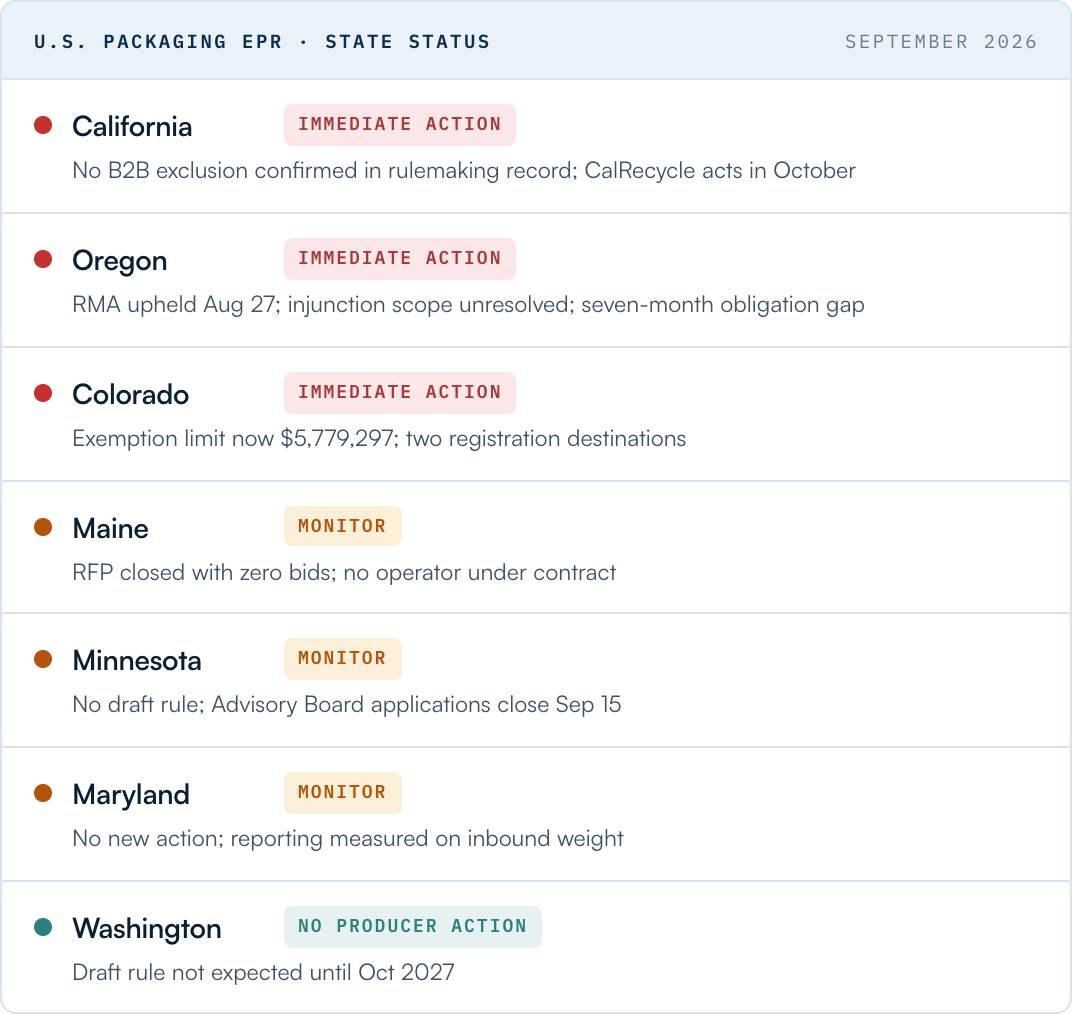
Litigation dominated August and, for the first time, produced an answer: Oregon's program was upheld on August 27. California and Colorado remain in active federal litigation over the same question of private fee-setting authority. Maine's implementation collapsed. Minnesota and Maryland moved at their usual pace. Washington remained dormant.
- The Individual Source Reduction (ISR) Plan deadline (August 3) and the CAA Program Plan comment window (closed August 14) passed as scheduled; early-fee invoices on 2025 supply data continued to issue.
- CAA submitted its program plan June 15, after the permanent regulations were finalized May 1. CalRecycle is expected to act on the plan and fee schedule in October — no specific date has been published.
- The rulemaking record settles the business-to-business question, and the answer is no. At response to comment B-23-3 CalRecycle stated "there is no business-to-business categorical exclusion under the Act," resting on PRC §42041(s)(3) — tertiary packaging protecting the product in transport — and on the view that "any time packaging is ultimately discarded by a business, that business was the consumer of that packaging." A Minnesota-style carve-out and a restaurant "dine-in deduction" were both pressed and both refused. CalRecycle added that it lacks authority to create exemptions the statute does not establish.
- The 17-state coalition amended its SB 54 complaint August 20 and moved for a preliminary injunction, adding a vagueness theory tied to July's SB 343 order; hearing January 15, 2027.
Why it matters — The answer sits in the responses to comments, not in the Statements of Reasons, which is why it is widely missed. This is not a gap awaiting guidance.
Action — Re-check any scoping that carved out B2B or transport packaging. If your figure rests on that assumption it is understated; correcting it before October is cheaper than after.
- On August 27 Judge Michael H. Simon held the RMA violates neither the Dormant Commerce Clause nor Due Process, after the July 13–17 bench trial and supplemental briefing through July 31.
- Two qualifications most coverage omitted. The February 6 injunction had not been dissolved on the docket at the time of the ruling, and no notice of appeal had been filed as of September 4. Several outlets reported the protection as lifted; the docket did not show that.
- What the injunction did: it restrained enforcement only. Producer obligations ran throughout, and retroactive penalties were expressly left open.
- Lollicup v. Feldon, the putative class action seeking similar protection for non-NAW producers, has all deadlines struck pending Feldon, with a joint status report due September 10.
Why it matters — Only one of these made headlines. The quieter one matters more to anyone inside the injunction: seven months of accrued-but-unperformed obligations, retroactivity unresolved, and the argument behind the shield now rejected.
Action — NAW members: treat Oregon as a remediation project this month. Assemble covered-material supply data from February forward, and confirm your docket position with counsel. Non-members: nothing changed.
- NAW filed NAW v. Ryan (D. Colo., 1:26-cv-03460) July 30 against HB 22-1355 on due-process, First Amendment and Commerce Clause grounds. Its August 5 expedited injunction motion presses only the undue-burden theory. The state's response is due September 16; no relief granted.
- The consolidated regulation took effect July 15 (6 CCR 1007-2 Part 1; Section 18 is the Producer Responsibility Regulations). The producer exemption limit rose to $5,779,297 on July 1, from $5,682,843 — realized gross total global revenue for the prior calendar year, excluding on-premises alcohol sales, indexed annually.
- Colorado has two registration destinations, not one. CAA is the designated PRO; Interchange 360 holds the only approved Individual Program Plan, covering petroleum and automotive products. In CDPHE's words, "some producers may be required to register with both CAA and Interchange 360, depending on the types of packaging they place on the Colorado market." Interchange 360's fees run back to program start and fall due within 30 days of registration.
- Records: five-year retention, production within ten business days of a department request, and inspection without prior notice during working hours. §18.2.6 bars recovering compliance costs through a point-of-sale fee.
- ILMA v. CDPHE, challenging the flat $0.56-per-gallon lubricants fee, remains undecided.
Why it matters — The two-registry point catches people: a producer registered with CAA may still owe registration and back-dated dues elsewhere. The exemption limit also moved mid-year.
Action — Check Interchange 360's product list before treating CAA registration as completing Colorado. Re-test exemption against $5,779,297. Confirm you can produce records inside ten business days.
- The stewardship-organization RFP closed August 18 with zero proposals, after CAA announced August 19 it would not bid. DEP is "assessing all options" for a program stalled at step four of nine since December 2024.
- The rule remains in force, with a test unique among the seven states. 06-096 C.M.R. ch. 428 §9(B) presumes packaging is received by the consumer "unless the producer can verify that the packaging material is not received by the consumer of the product," in which case it is not reported. The rule also contemplates an authorized third-party reporter, identified by a named responsible individual.
Why it matters, and what to do — No producer deadline is running and none can start without an operator. But Maine keys reporting to receipt by the consumer rather than to the producer's act of supply — the only one of the seven where unsold stock returned unopened can leave the reported figure, on documentary verification, with the burden on the producer. Nothing to file; if your Maine figure will eventually exclude returns, preserve that evidence now.
- Rulemaking has not moved. MPCA issued a request for comments May 26 and has published no draft. The rules are expected to cover definitions, exemptions, collection lists and measurement — but the statute governs until they exist.
- Advisory Board applications close at noon CDT on September 15, for four-year terms beginning January 1, 2027. Seats include manufacturers of covered materials and the trade associations representing them. Employees of a producer required to be a PRO member may not serve. The next board meeting is September 16; the Needs Assessment remains due December 31.
Why it matters, and what to do — The board comments on rule language and on the forthcoming stewardship plan — the earliest point of influence on Minnesota's measurement rules, and the eligibility bar routes those seats to trade associations rather than producers. If you work through one, September 15 is their deadline; otherwise watch September 16 for the first signal on rule timing.
- No new regulatory action in August; MDE's June 2026 compliance guide, FAQs and exemption determination form remain operative. CAA's July 1 registration is still the participating-producer list.
- COMAR 26.04.14 measures volume "by weight distributed into the State during the previous calendar year" — the inbound leg only, with exactly one added exclusion, for packaging intended to be ingested.
Why it matters, and what to do — That makes Maryland the strictest of the seven: no out-of-state carve-out and no adjustment for where material is discarded, so documented onward shipment does not reduce the figure and destination-based apportionment used elsewhere does not transfer. Confirm you appear on the filed participating-producer list, and check your Maryland figure is built on inbound weight.
- Chapter 173-950 WAC rulemaking began March 19, with a draft not expected until October 2027 and adoption around April 2028. E2SSB 5284 governs until then. The preliminary needs assessment is due December 31, 2026, and the prohibition on selling covered materials without program participation takes effect March 1, 2029.
Why it matters, and what to do — The timeline is longer than the law's existence suggests, and the fee basis will come from the needs assessment rather than the rule text. No filing; keep Washington simplified supply data current.
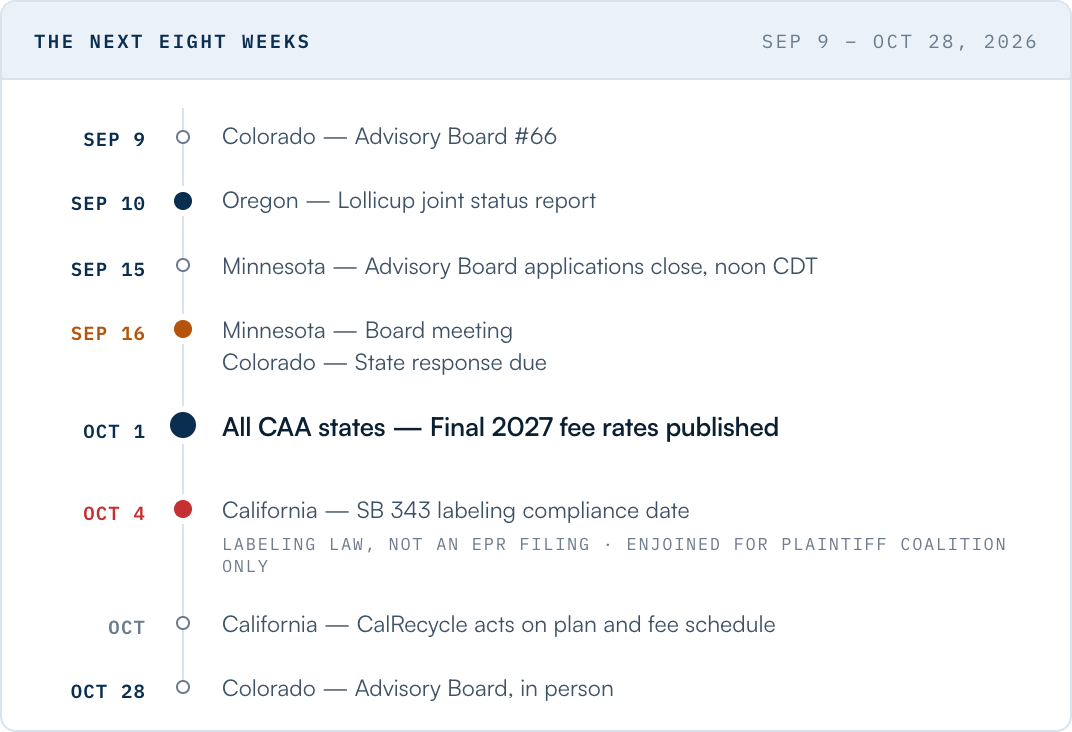
Upcoming Deadlines
Dates run through January 2027.
| Date | Requirement | Applies to | Type |
|---|---|---|---|
| Beginning this month | |||
| Sep 9 | Colorado — Producer Responsibility Advisory Board #66, incl. the Department's overview of program-plan amendment procedure | Colorado producers | Watch |
| Sep 10 | Oregon — Lollicup v. Feldon joint status report due; sets the class action's path after Feldon | Non-NAW Oregon producers | Watch |
| Later this month | |||
| Sep 15 noon CDT |
Minnesota — Advisory Board applications close, terms from Jan 1, 2027 | Trade associations; not producer employees | Consultation |
| Sep 16 | Minnesota — Packaging EPR Advisory Board meeting | Minnesota producers | Watch |
| Sep 16 | Colorado — State's response due to NAW's preliminary injunction motion | Colorado producers | Watch |
| Coming soon | |||
| Oct 1 | All CAA states — Final 2027 CAA fee rates due from CAA no later than this date | All CAA-registered producers | Watch |
| Oct 4 | California — SB 343 labeling compliance date (labeling law, not an EPR filing), applying to packaging manufactured after this date; enforcement enjoined as to the plaintiff coalition only | Producers outside the coalition | Mandatory |
| October | California — CalRecycle expected to act on CAA's program plan and fee schedule; no specific date published | All SB 54 producers | Watch |
| October | Colorado — Producer dues schedules set annually, separately by CAA and by Interchange 360 | Colorado producers | Watch |
| Oct 28 | Colorado — Advisory Board, in-person; agenda settled at the Sep 9 session | Colorado producers | Watch |
| Dec 31 | Washington — Ecology preliminary needs assessment due | Fee-basis input | Watch |
| Dec 31 | Minnesota — Needs Assessment due | Fee-basis input | Watch |
| Later | |||
| Jan 1, 2027 | California — Full SB 54 implementation; annual producer fees begin | All SB 54 producers | Mandatory |
| Jan 15, 2027 | California — Preliminary injunction hearing, NAW-led coalition v. SB 54 | Monitor | Watch |
Urgency is carried by the group headings, so color means one thing only.
October 4 is back on your calendar unless you are a plaintiff.
August's issue told readers to delete the October 4 SB 343 labeling deadline on the strength of July's preliminary injunction. That was too broad, and we are correcting it here rather than quietly dropping it. The injunction restrains the California Attorney General from enforcing the labeling restrictions as to the plaintiff coalition — the industry groups that brought the case — not as to the market at large. The compliance date stands, and applies to packaging manufactured after October 4, 2026.
If you are not a member of a plaintiff organization, treat October 4 as live. Environmental groups moved to intervene on July 27; the motion was set for decision on August 31 without oral argument, and no ruling had been published as of September 4. The scope may yet move again. This is the same reading error the Oregon injunction produced, one state over: relief that runs to the parties gets reported as relief that runs to everyone.
Oregon — the seven months nobody was watching
Read the February injunction carefully and it says something narrower than how it was received. It barred DEQ from enforcing the Recycling Modernization Act against NAW members while the case was pending — it did not suspend the RMA's requirements. For producers within its scope, registration, reporting and fee obligations have accrued continuously since February 6: unenforced, but not excused. The court also declined to resolve whether daily penalties could later be assessed retroactively if DEQ won. DEQ won.
Scope is worth checking rather than assuming. The order ran to NAW and its members, and the published sources do not settle whether it reached companies that joined after February 6, 2026. If your protection depended on membership timing, that is a question for counsel and not one to answer from a newsletter.
Nothing has been announced about retroactive assessment, and possibly nothing will be. But the practical position has inverted: a producer who treated the injunction as a pause now has roughly seven months of covered-material supply never compiled, never reported and never paid, and the argument the shield rested on has been rejected on a full trial record. The reconstruction problem follows every enforcement pause — the data is hardest to assemble precisely for the period when nobody was collecting it. Build that record while the underlying transaction data is still accessible, not after a demand arrives with a deadline attached.
New Guidance & Resources
August's documents were mostly litigation filings rather than agency guidance. One of them is now the most important document in U.S. packaging EPR.
Oregon — Findings of fact and conclusions of law, NAW v. Feldon (August 27, 2026)
Why read it: the first merits ruling on the constitutionality of a state packaging EPR program. The court rejected the private-fee-setting due process theory on a full trial record and decided the exemption challenges on evidentiary failure rather than legal principle — which shapes how the next challenger has to build its case.
Oregon — The February 6 preliminary injunction, on its own terms
Why read it: the order's scope is the whole story for NAW members — it stopped DEQ enforcement, not the RMA's requirements, and left retroactive daily penalties unresolved.
California — SB 54 comment matrices, 45-day (1,224 comments) and 15-day (382)
Why read it: where CalRecycle answered the business-to-business question. It is not in the Initial or Final Statement of Reasons — neither contains the phrase. Responses B-23-3, O-38-1 and B-39-2 carry the rejection, the tertiary-packaging reasoning, and the statement that CalRecycle cannot create exemptions the statute does not establish.
Colorado — 6 CCR 1007-2 Part 1, version effective July 15, 2026
Why read it: Section 18 carries the current exemption limit, the five-year records rule, the ten-business-day production window and the no-notice inspection right. Take the version identifier from the publisher's version page, not from a search result.
Colorado and California — the two live challenges (July 30 / August 5 and August 20, 2026)
Why read it: Colorado is the first test of the private-fee-setting theory argued in Oregon, pressed on a narrower Commerce Clause ground; California's amended complaint adds a vagueness theory tied to the SB 343 injunction. Together they show where the argument goes next after Oregon.
Maine — DEP statement on the failed RFP, and CAA's explanation for declining to bid (August 19–20, 2026)
Why read it: together these are the operative record of where Maine stands — the state assessing options, and the dominant PRO describing in its own words the bar a program must clear before it will run it.
Operational Practice Watch
A stipulation pauses one thing, not everything
Oregon's Lollicup stipulation shows how narrow a litigation pause actually is. It stopped one action — DEQ issuing pre-enforcement notices against the putative class — and ran only through August 31, with no extension published as of September 4. It never stopped registration, reporting or payment, never stopped DEQ investigating, and never bound CAA at all: CAA could still invoice class members, pursue non-payment and publish them on its non-compliance list, because it is not a party.
The Oregon ruling turns this from a drafting observation into an accounting problem. The February injunction barred DEQ enforcement against NAW members and did not touch the obligations, which have accrued since February 6. Anyone whose posture rested on that order was accumulating a liability the whole time it held. A preliminary injunction, a stipulation and a stay all end, and none retire the underlying duty; at best they defer the moment someone asks you to prove it. Enforcement paused versus obligation extinguished is the most consequential distinction a producer can misread here, and it is misread constantly.
Know which of your sources has a version number
Two habits separate a defensible compliance file from a confident guess, and both showed up this month. First: a regulation has versions, and the one a search engine returns is not necessarily the one in force. In an older edition of Colorado's solid waste regulations, Section 18 governs waste grease transporters; in the version in force it is the Producer Responsibility Regulations. Take the identifier from the publisher's version page.
Second: some agency documents are not fixed objects at all. CDPHE's revised Producer Responsibility FAQ, announced September 2, is published as a live Google Doc that re-publishes every few minutes and carries no version number — it can change without notice and without leaving a trace. That makes it useful navigation to the statute, and unusable as a citation. Date and archive your own copy the day you read it, or you cannot later show what the guidance said when you acted on it.
When the PRO says no
CAA's decision not to bid on Maine is a signal, not just an outcome. A private organization choosing which state programs to run — and which to decline — is itself a form of market power over how packaging EPR gets implemented nationally. Producers evaluating exposure across multiple states should treat "CAA operates this program" as a variable, not a constant.
"Presented no evidence other than speculation."
The most-watched constitutional challenge in U.S. packaging EPR did not fail on a legal question. It failed on proof. Industry has argued that private fee-setting unconstitutionally burdens interstate commerce; given five days of trial to show it, the challenger could not put enough evidence before the court to shift the standard of review. That is a narrower loss than a ruling on principle — and a harder one to fix on appeal, because the record is closed. It sets the bar for Colorado and California: the theory is not dead, but the next plaintiff needs facts, not forecasts.
(CAA's own explanation for walking away from Maine — its "operational practices, systems and data stewardship standards" — is quoted in section 1, and remains the sentence that explains why the country's first packaging EPR law still has no operator.)
Orbitlex Perspective
Until now it has been possible to treat packaging EPR as provisional — obligations that might yet be struck down, and therefore might not be worth building capability around. August ended that posture in the only way it could end: not with an argument but with a ruling. The most serious challenge available was brought by a well-resourced plaintiff, tried on the merits over five days, and lost on the evidence.
What follows is less dramatic than either side will claim: the ruling binds no other court, an appeal is available, Colorado and California are live. But the burden has shifted. Waiting for the courts to remove these programs no longer has a plausible timeline attached, and the producers who used that uncertainty to defer data work are furthest behind — the thing they waited for arrived and went the other way. Maine is the counterweight against overcorrecting: a program can be perfectly lawful and still not exist. The posture across all seven states is unchanged — know what applies to you today, keep the packaging data current whether or not anyone is invoicing you, and treat every form of litigation relief as temporary.
- Whether DEQ or CAA pursues the February–August period — no retroactive assessment has been announced against former injunction beneficiaries. The open question with the largest number attached to it.
- Docket movement in NAW v. Feldon — whether the February injunction is formally dissolved, and whether NAW files an appeal.
- Lollicup joint status report, September 10 — whether the class action proceeds, and with it whether class-wide relief stays realistic for non-NAW producers.
- Colorado response brief, September 16 — the state's opposition to NAW's injunction motion, and the first test of how the Oregon decision travels.
Not sure which of these obligations apply to your business?
Get a free EPR Compliance Status Check